Full article
Women are leading migration. Governance must transform with them.
Labour migration is not gender neutral. A justice-centred response must recognise women’s agency while changing the unequal systems that shape recruitment, work, mobility, reporting and access to remedies.
Feminisation is about more than numbers
Women have always migrated. The feminisation of migration should therefore not be reduced to a claim that women have only recently entered migration flows. It also describes a qualitative change: women increasingly migrate as workers in their own right, make migration decisions, sustain households and contribute to national economies as primary earners and providers.
At the same time, gender norms influence who migrates, the work available to them, the risks they encounter and the resources they can use when something goes wrong. Women and men frequently migrate under different circumstances, enter different sectors of employment, experience different forms of exploitation and encounter distinct barriers to justice.
Gendered labour markets concentrate women in undervalued work
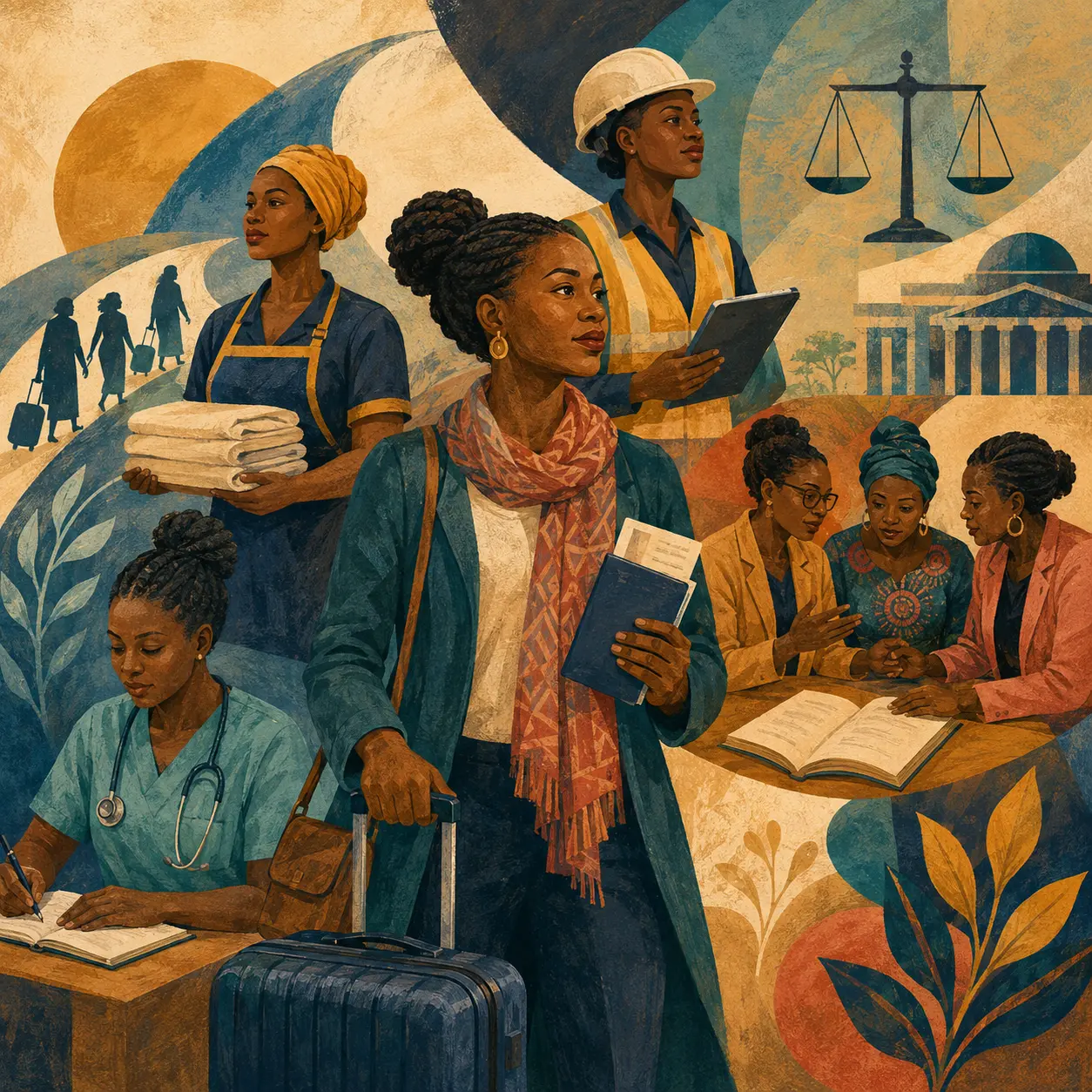
In Kenya’s labour-migration corridors to Gulf countries and the wider Arab region, women are heavily concentrated in domestic work, caregiving, hospitality, cleaning, beauty services and other feminised sectors. This concentration reflects unequal economic opportunities and persistent expectations that associate women with domestic and caregiving responsibilities.
Domestic and care work are socially and economically indispensable, but they remain widely undervalued. When work is performed inside private households, ordinary workplace oversight, labour inspection, peer support and access to independent evidence may be weak or absent. A worker may also depend on an employer for accommodation, food, immigration status, communication and mobility. These conditions can heighten exposure to exploitation and make reporting or leaving unsafe work substantially more difficult.
Power can operate across overlapping legal and social systems
Many migrant workers in Gulf countries work within sponsorship arrangements that connect employment with residence and immigration status. Although reforms differ across jurisdictions, employer-linked status can create serious power imbalances where workers cannot freely change employment, leave a workplace or regularise their position without the involvement of a sponsor or public authority.
For women, these constraints may intersect with gendered restrictions, discriminatory social norms and unequal access to healthcare, accommodation, administrative procedures and legal assistance. Effective representation therefore requires attention not only to labour law, but also to immigration rules, criminal law, family law, civil registration, child protection, nationality, consular procedures and available protection mechanisms.
Gender-specific harms must be visible in legal analysis
Sexual and gender-based violence may occur during recruitment, transit, employment, repatriation or reintegration. Harassment, assault, reproductive coercion, psychological violence and threats often arise within broader patterns of control, dependency and unequal power. Restrictions on mobility, insecure status, stigma and fear of retaliation may delay disclosure or prevent reporting altogether. These circumstances matter when practitioners assess evidentiary gaps, delayed reporting and the support needed for safe participation in a legal process.
Pregnancy, reproductive health, caregiving responsibilities and family status may also shape the harm experienced and the remedies required. Women may face barriers involving healthcare, birth registration, identity and travel documents for children born abroad, family unity and reunification. These are not peripheral concerns: they affect safety, legal status, return, recovery and long-term access to justice for women and their children.
What a gender-transformative approach requires
A gender-responsive intervention recognises different needs and risks. A gender-transformative approach goes further: it seeks to change the unequal power relations, norms and institutional practices that produce those risks and obstruct justice.
- Centre women’s voice, informed choice, leadership and collective participation throughout policy and programme design.
- Recognise domestic and care work as work entitled to equal labour protection, social protection and effective enforcement.
- Build fair-recruitment systems that prevent debt, deception, contract substitution and the transfer of business risk to workers.
- Create safe, accessible and confidential reporting channels that do not depend on an employer or recruiter.
- Preserve evidence and legal options across borders, including after repatriation.
- Address sexual and gender-based violence, reproductive harm, disability, family separation and documentation barriers within legal assessment and remedies.
- Hold recruiters, employers, intermediaries and public institutions accountable for their respective conduct and duties.
- Design return and reintegration around autonomy, recovery, economic justice and guarantees of non-repetition—not around return alone.
Access to justice must travel with the worker
Women’s migration is an exercise of agency, aspiration and economic participation. Protection systems should not respond by limiting women’s mobility or treating them only as vulnerable. They should expand the conditions in which women can migrate safely, work with dignity, report abuse without retaliation and pursue remedies wherever harm occurs.
That shift requires institutions in countries of origin and destination to coordinate across the full migration cycle. Prevention, urgent protection and repatriation remain important, but they must connect to evidence preservation, legal representation, compensation, rehabilitation, accountability and structural reform. Gender transformation means changing who holds power, whose work is valued and whether rights can be enforced in practice.